
Concussion Treatment in Langley : Understanding the Problems That Can Get in the Way of Recovery
A concussion does not always look dramatic from the outside.
Someone may be walking normally but struggle to concentrate at work. A student may find a busy classroom overwhelming. An athlete may feel ready to exercise but notice dizziness when moving their head.
These experiences can make returning to everyday life difficult, even when the original injury happened days or weeks earlier.
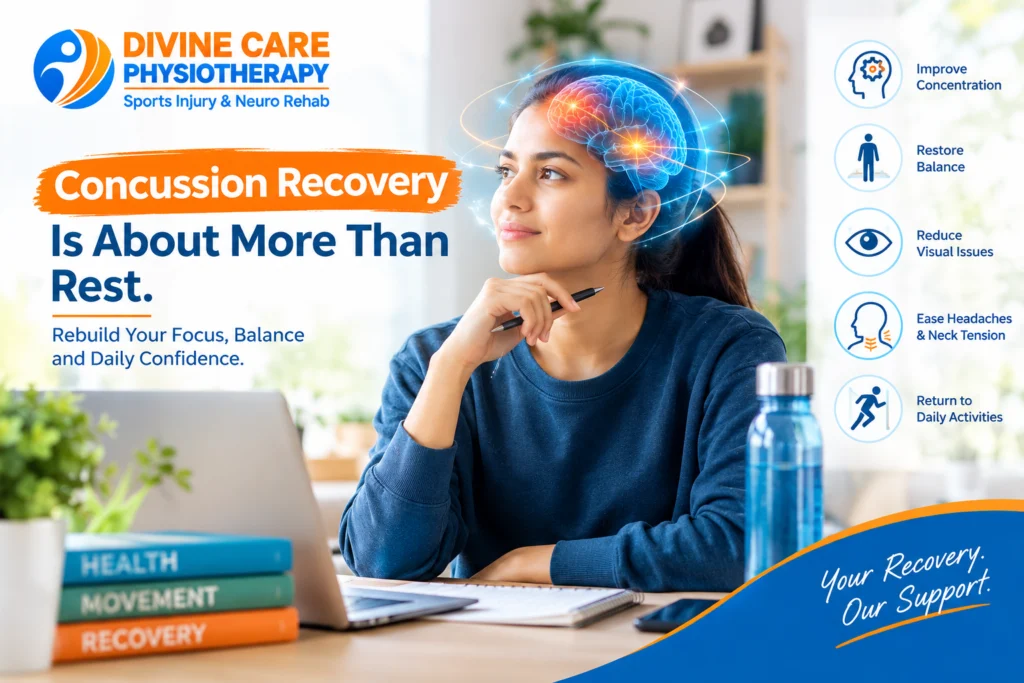
At Divine Care Physiotherapy in Langley, concussion management is one of the clinic’s listed services, alongside vestibular rehabilitation and sports physiotherapy. The clinic’s concussion information recognizes that symptoms may involve balance, concentration, vision, fatigue and the neck or vestibular system.
The important question is not simply whether you can resume your routine. It is which parts of that routine are still difficult, and what kind of assessment or support may be appropriate?
A Concussion Can Affect More Than One Part of Your Day
Instead of judging recovery by a single symptom, look at the activities that have changed.
Everyday situation | What you might notice | What deserves attention |
Working on a computer | Headache, fatigue or difficulty concentrating | Screen tolerance, workload and breaks |
Walking through a busy place | Dizziness, unsteadiness or visual discomfort | Balance and movement-related symptoms |
Reading or studying | Reduced concentration or mental fatigue | Cognitive demands and a gradual return to learning |
Turning your head | Neck discomfort or dizziness | Whether cervical or vestibular assessment is appropriate |
Exercising | Symptoms increase with physical effort | Medical guidance and an appropriate activity progression |
Returning to sport | Feeling better but not yet tolerating sport demands | A supervised, graduated return-to-sport process |
These examples are not a way to diagnose a concussion at home. Similar symptoms can have different causes, and a healthcare professional should assess a suspected concussion.
The Problem May Be the Activity, Not Just the Symptom
Consider three everyday examples.
The employee who cannot get through a full workday
Reading, meetings, screen time and a noisy workplace may place different demands on someone recovering from a concussion. A gradual return to work, with suitable adjustments where needed, may be more manageable than immediately attempting a full routine.
The student who struggles in a busy classroom
Concentration, bright environments, movement and social interaction can make school feel more demanding. A return-to-learning plan can help increase academic activity progressively, with breaks or adjustments when appropriate.
The athlete who feels ready to play
Being able to walk or perform light exercise does not automatically mean someone is ready for contact, rapid changes of direction or full competition. Return to sport should follow a graduated process and the required medical clearance.
The common thread is that recovery involves more than waiting for a symptom to disappear. It also involves understanding activity tolerance and returning to responsibilities safely.
Where Concussion Physiotherapy May Fit
Concussion care is not identical for every person. Medical assessment is important, and rehabilitation should be selected according to the symptoms, clinical findings and recovery needs.
At Divine Care Physiotherapy, the clinic’s published information identifies concussion management and vestibular rehabilitation among its services. Depending on an individual assessment and the advice of the appropriate healthcare professional, rehabilitation may need to consider several overlapping areas.
Balance and dizziness
If head movement, walking or changes in position trigger dizziness or unsteadiness, a vestibular assessment may help determine whether vestibular rehabilitation is appropriate.
Learn more about Vestibular Rehabilitation in Langley.
Neck-related symptoms
Neck pain or stiffness can occur alongside concussion. When present, cervical issues may need to be assessed as part of the wider clinical picture rather than assuming every symptom comes from the concussion alone.
Physical activity and sport
Activity progression should match the person’s symptoms, abilities and stage of recovery. Athletes should not return to contact sport simply because they feel better; medical clearance and a graduated return-to-sport strategy are important.
Explore Sports Physiotherapy and Youth Sports Physiotherapy.
Everyday function
The goal is to understand which activities have become difficult and what support may be appropriate. A rehabilitation plan should be individualized, not built around a fixed set of exercises for everyone.
Rest Matters. So Does the Return to Activity.
Older advice sometimes suggested staying in complete rest until all symptoms disappeared. Current Canadian guidance generally recommends a brief period of relative rest typically the first 24 to 48 hours followed by a gradual return to everyday activities as tolerated.
That does not mean pushing through significant symptoms or returning straight to strenuous exercise. Activities should be increased progressively and any return to sport must follow the appropriate medical guidance and clearance process.
If symptoms persist, interfere with daily life or become difficult to manage, seek follow-up from a qualified healthcare professional. A personalized plan may be needed.
For more information, consult Parachute Canada’s concussion guidance.
How Divine Care Physiotherapy Approaches Post-Surgical Rehabilitation
At Divine Care Physiotherapy in Langley, post-surgical rehabilitation is individualized around the surgery, healing stage, current mobility, strength, functional limitations, specialist instructions and personal goals.
Depending on the assessment, rehabilitation may include:
- Exercise therapy: exercises selected to address appropriate mobility, strength, flexibility, balance and functional needs.
- Active rehabilitation: progressive exercise-based work toward daily activities, work, recreation or sport where appropriate.
- Movement and mobility work: strategies selected according to the procedure and permitted movement.
- Education and home exercises: guidance to help you understand your plan and continue appropriate work between appointments.
- Selected additional treatments: Class IV laser therapy or taping may be considered when appropriate; neither is automatically required for every post-surgical patient.
The aim is to build a plan around the individual, not to apply every available treatment to every surgery.
You can read more on Divine Care’s Post-Surgical Physiotherapy in Langley page.
Important: Know When to Seek Urgent Medical Help
Physiotherapy is not a substitute for emergency assessment after a serious head injury.
Call 911 or seek emergency care immediately if a person has warning signs such as:
- A severe or increasing headache
- Repeated vomiting
- A seizure or convulsion
- Increasing confusion, agitation or difficulty staying awake
- Loss of consciousness
- New weakness or tingling in the arms or legs
- Double vision or a deteriorating level of consciousness
Do not wait for a physiotherapy appointment if these signs occur. For suspected concussion, obtain prompt medical assessment.
Looking for Concussion Treatment in Langley?
If concussion symptoms are affecting your balance, movement or return to everyday activities, the next step is to understand the problem rather than guessing which treatment you need.
Divine Care Physiotherapy offers concussion management and vestibular rehabilitation in Langley. An appointment provides an opportunity to discuss your concerns, review relevant history and determine whether physiotherapy assessment is appropriate as part of your care.
Divine Care Physiotherapy
D109 – 20159 88 Ave, Thunderbird Village
Langley, BC V1M 0A4
Phone: 604-401-2946
Email: info@divinecarephysio.com
Book an appointment or visit the clinic’s Concussion Treatment in Langley.